Visca
Solutions/Industry

Financial services

Account data, balances, and PII can't go to a hosted model. The whole stack has to run inside the bank.

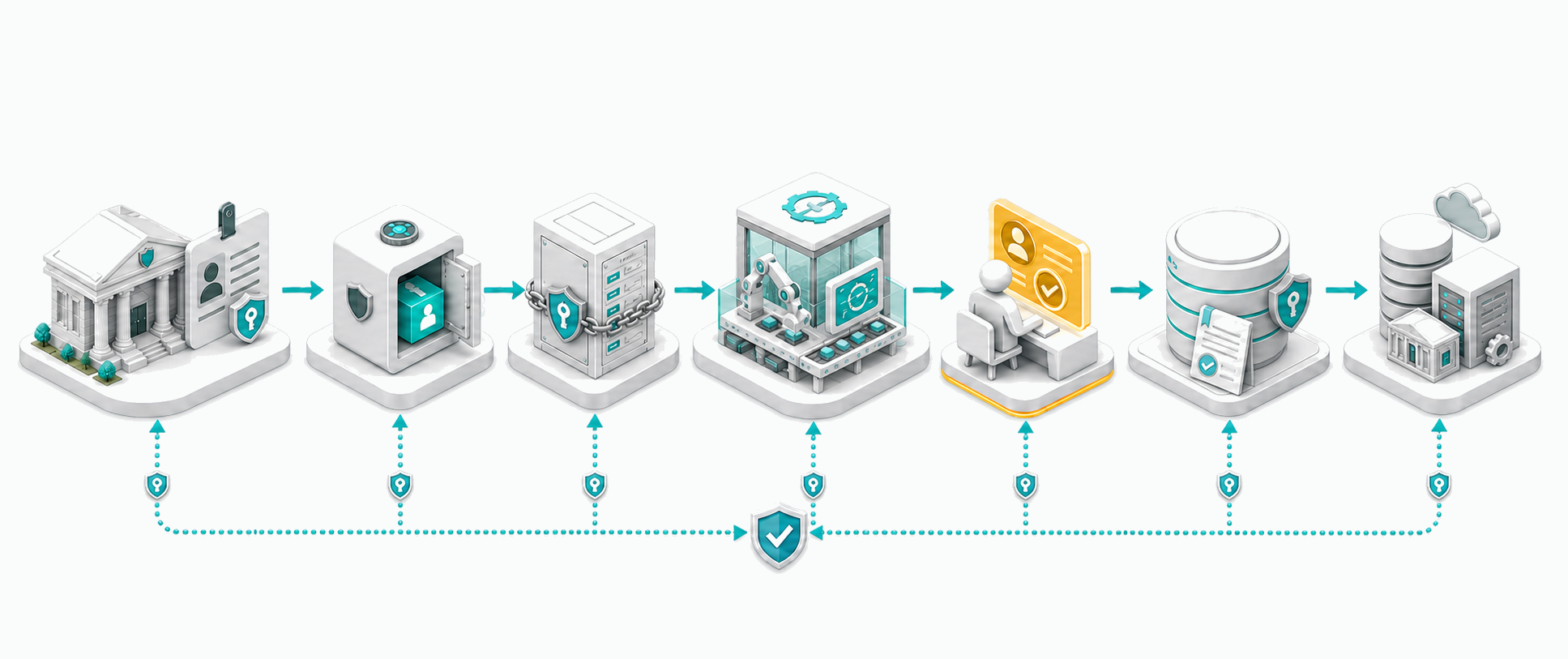
Account numbers, balances, transaction histories, and customer PII are exactly the data a bank cannot send to a dozen hosted AI vendors — every outbound call to a model, auth, or voice API is data egress that dies at the security review. Self-hosting is the only acceptable shape, but stitching it from a model server, an identity project, a secrets manager, an audit pipeline, and a payments integration leaves the bank owning brittle seams between layers no examiner trusts. Visca is the entire stack — models in-perimeter, identity, scoped access, and a tamper-evident record — as one ecosystem, self-hosted inside the bank's own walls.

Why the data can't leave

Hosted AI is out. A stitched stack is the only thing left — and it breaks here.

Service accounts with the keys to the core

Fraud and reconciliation agents are wired to core banking, payment rails, and ledgers through long-lived service accounts with broad scope. A prompt injection or a compromised runtime becomes a movement-of-funds incident.

No examiner-ready record

When an auditor asks 'which automated process issued this refund, under whose authority, and what did it see' — the answer is stitched together from framework traces, vendor logs, and a screenshot. That gap blocks production sign-off.

A stitched stack no CISO will sign

Hosted agent platforms move prompts, transaction context, and outputs through infrastructure no bank CISO will approve, so self-hosting is the only option. But assembling it from a half-dozen open-source projects and vendors — each its own identity, audit trail, and upgrade cycle — leaves brittle seams the bank owns forever, and most teams don't want to build or operate either path.

One ecosystem, not a stitched stack

One self-hosted ecosystem, applied to financial services.

Warrant

Per-action access to money and records

Every reach into a ledger, a payment processor, or a card network is a Capability Grant — scoped to verb, amount, counterparty, and duration. The agent never holds a standing credential to the core.

Chronicle

An examiner-ready system of record

Every action keyed by Sigil and Capability Grant, cryptographically chained and tamper-evident. 'Who issued this refund, under whose authority, with what consent trail' is one query, exportable to your SIEM and GRC tools.

Sigil

Identity for every automated actor

Each agent, and each run, carries a cryptographic identity bound to the human or system that authorized it. Revocation propagates across the estate in seconds.

Lattice Runtime

Cost and blast-radius governance

Per-actor budgets and circuit breakers cap exposure. A runaway process is a bounded process, not an unbounded one.

What you get

Outcomes.

Relevant frameworks

SOC 2 Type IIPCI-DSSISO 27001GDPR / regional residency

Visca Cloud has not yet completed formal certification against these frameworks; the stack is architected to meet them and audits are in progress. See the compliance roadmap.

In practice

A duplicate-charge refund agent

A support agent detects a duplicate charge and requests a Capability Grant scoped to refund:create, capped at $50, for this one customer, valid for thirty minutes. Warrant checks policy, optionally requires human consent, and vends an ephemeral credential. Chronicle records the detection, the grant, the consent, and the refund as one chained event. When compliance reviews the quarter, every refund the estate issued is one SQL query away.

Other industries

The whole stack. Self-hosted. One ecosystem.

The entire agent stack, inside your own walls.

Models, identity, tools, voice, payments, runtime, and audit — as one integrated ecosystem, self-hosted, sovereign, air-gapped. Nothing stitched from vendors. Nothing leaves your perimeter. Open at the core. No license rug-pulls, ever.