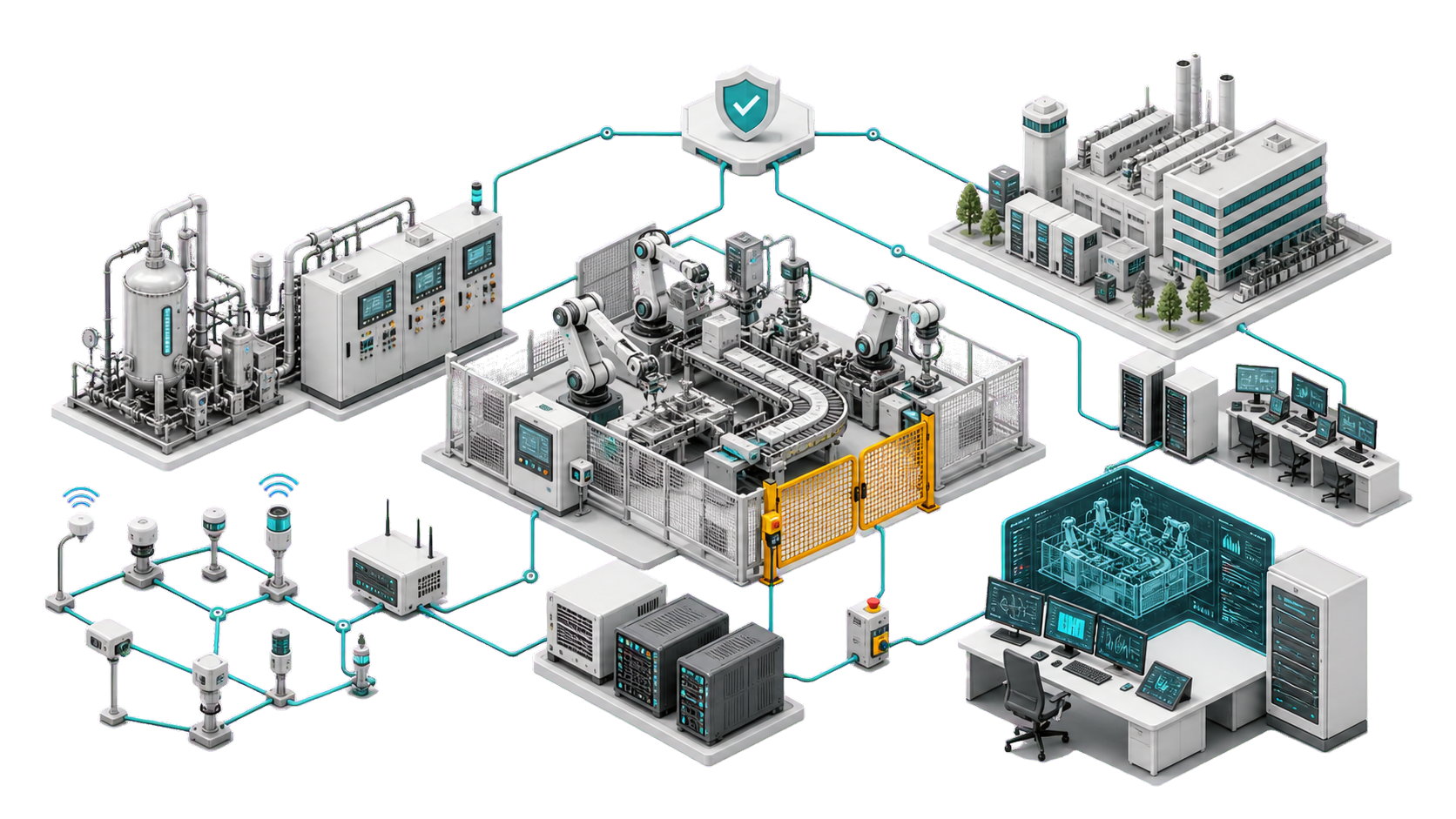
Process recipes and plant telemetry stay on the floor — on one self-hosted ecosystem, not a stack stitched per vendor.
Manufacturing and energy operations run hybrid fleets of software planners, PLCs, and physical machines — and the process recipes, yield data, and plant telemetry that move through them are trade-secret data that stays on the floor, off any vendor cloud. Today that means a stitched stack: planners on one platform, machines in vendor consoles, safety in application code, and audit scattered across clouds, bolted on per line, per site, per vendor. Visca declares and operates the whole estate as one self-hosted ecosystem — one identity model, one runtime with safety envelopes, one record — inside your own network.
Why the data can't leave
Fleet configurations live in middleware configs, vendor consoles, and tribal knowledge. Two sites drift apart, and nobody can diff them.
Operational limits and interlocks are written into application logic, differently by every team. Auditing them is reading code, not reading a policy.
When a line faults, telemetry is in one vendor's cloud, interventions in another log. Reconstructing the sequence takes days.
One ecosystem, not a stitched stack
Machines, capabilities, behavior trees, and safety envelopes declared in one Cast plan. Plan, apply, diff, drift detection — every site identical by design.
Planners and machines scheduled on one runtime, with behavioral safety envelopes enforced uniformly — geofences, force limits, allowed operations.
Each machine carries an attested Sigil. Commands are cryptographically attributable to a specific machine in a specific configuration.
Every planner decision, actuation, and operator intervention in one chained record. A line fault is reconstructed in minutes, not days.
What you get
Relevant frameworks
Visca Cloud has not yet completed formal certification against these frameworks; the stack is architected to meet them and audits are in progress. See the compliance roadmap.
In practice
A packaging line halts on a safety interlock. The postmortem is a Chronicle replay: the planner's command, the Capability Grant behind it, the attested machine identity, the envelope check that tripped, and the operator's reset — one timeline, across planner software and floor hardware, reconstructed in minutes.
Account data, balances, and PII can't go to a hosted model. The whole stack has to run inside the bank.
PHI can't be shipped to a model API. The scribe, the audit, and the model all have to live in your tenancy.
Operational telemetry stays on-site, and software agents and robots run on one self-hosted ecosystem.
Classified and sensitive data never leaves the boundary — so the entire stack has to run inside it, air-gapped.
Pricing, sourcing, and customer data each stay inside their own walls — across a stack neither company could stitch alone.
The whole stack. Self-hosted. One ecosystem.
Models, identity, tools, voice, payments, runtime, and audit — as one integrated ecosystem, self-hosted, sovereign, air-gapped. Nothing stitched from vendors. Nothing leaves your perimeter. Open at the core. No license rug-pulls, ever.