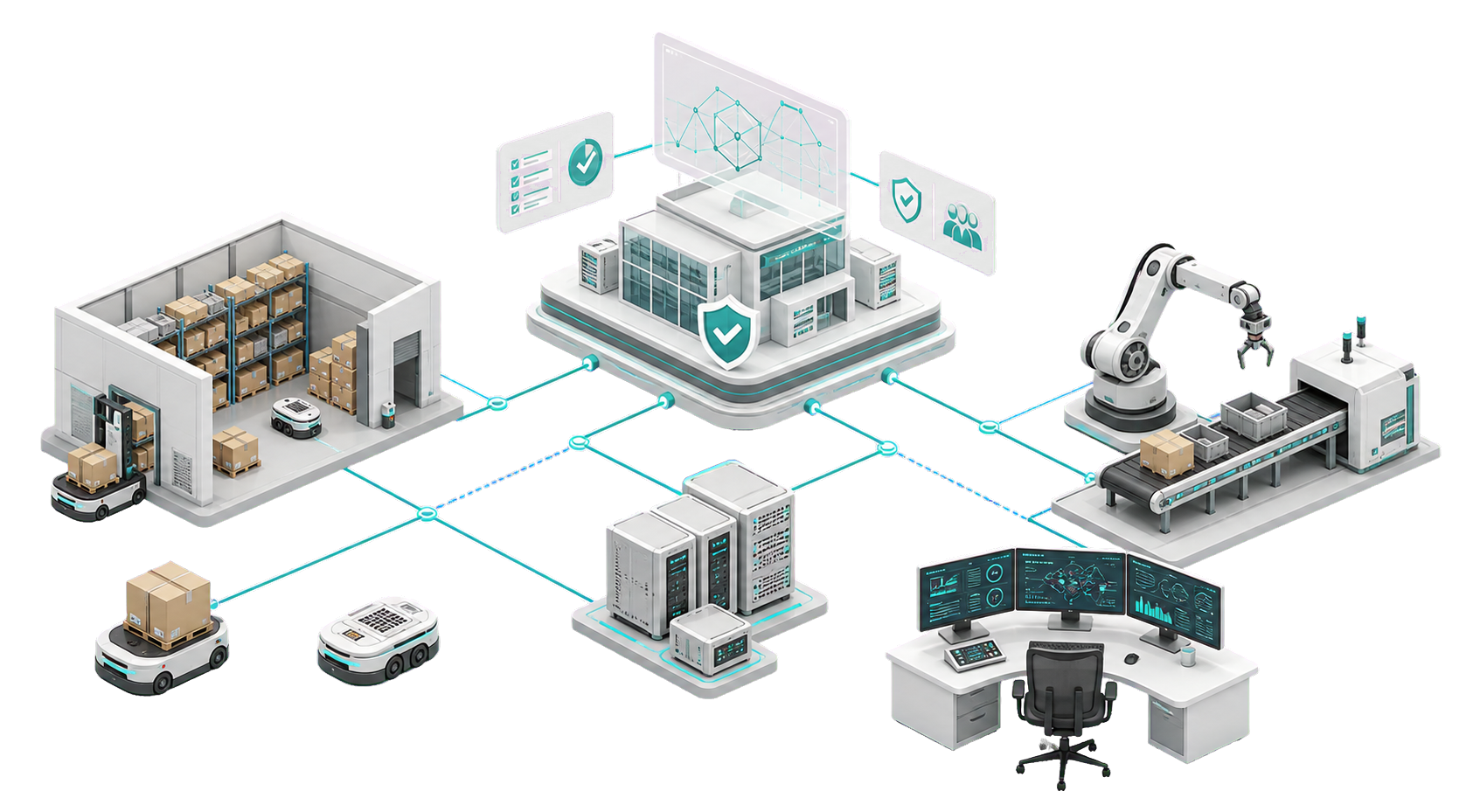
Operational telemetry stays on-site, and software agents and robots run on one self-hosted ecosystem.
Warehouses, ports, and distribution networks run software planners that command physical robots — and the operational telemetry, layouts, and customer shipment data they generate are competitive and contractual data that stays inside the facility, not on a vendor's cloud. The default alternative is a stitched stack: software agents on one cloud platform, robots on vendor middleware with its own identity and logging, and no shared, self-hosted answer to who did what across the boundary. Visca runs both as one ecosystem — software and embodied actors under one identity model, one runtime, and one record — self-hosted across cloud, edge, and on-robot compute.
Why the data can't leave
Software agents run on one stack; robots run on robotics middleware with its own identity, logging, and deployment. There's no shared answer to who did what across the boundary.
A robot is a serial number plus whatever firmware-signing the vendor ships. A receiving system can't cryptographically verify that a command came from a specific physical machine in a specific configuration.
Geofences, force limits, and allowed-operation constraints are coded differently for every robot vendor — inconsistent, hard to audit, easy to drift.
One ecosystem, not a stitched stack
Each robot mints a Sigil at boot, rooted in TPM or Secure Enclave attestation. A verifier confirms the request came from a specific robot, running specific firmware, in a specific configuration.
Software planners and embodied actors schedule on the same runtime, with behavioral safety envelopes — geofences, force limits, allowed operations — enforced uniformly.
Every planner decision, every actuation, every operator intervention lands in one Chronicle — Sigil-keyed, chained, replayable as a single timeline.
Firmware, model weights, behavior trees, and sensor calibrations packaged as one signed Seal Bundle. Reproducible to the byte for incident review.
What you get
Relevant frameworks
Visca Cloud has not yet completed formal certification against these frameworks; the stack is architected to meet them and audits are in progress. See the compliance roadmap.
In practice
A pallet is mis-routed. With Visca, the investigation is a single Chronicle query: the planner's decision, the Capability Grant that authorized the move command, the specific robot's hardware-attested Sigil, the actuation telemetry, and the operator override — one timeline, replayable, across cloud and on-robot.
Account data, balances, and PII can't go to a hosted model. The whole stack has to run inside the bank.
PHI can't be shipped to a model API. The scribe, the audit, and the model all have to live in your tenancy.
Classified and sensitive data never leaves the boundary — so the entire stack has to run inside it, air-gapped.
Pricing, sourcing, and customer data each stay inside their own walls — across a stack neither company could stitch alone.
Process recipes and plant telemetry stay on the floor — on one self-hosted ecosystem, not a stack stitched per vendor.
The whole stack. Self-hosted. One ecosystem.
Models, identity, tools, voice, payments, runtime, and audit — as one integrated ecosystem, self-hosted, sovereign, air-gapped. Nothing stitched from vendors. Nothing leaves your perimeter. Open at the core. No license rug-pulls, ever.