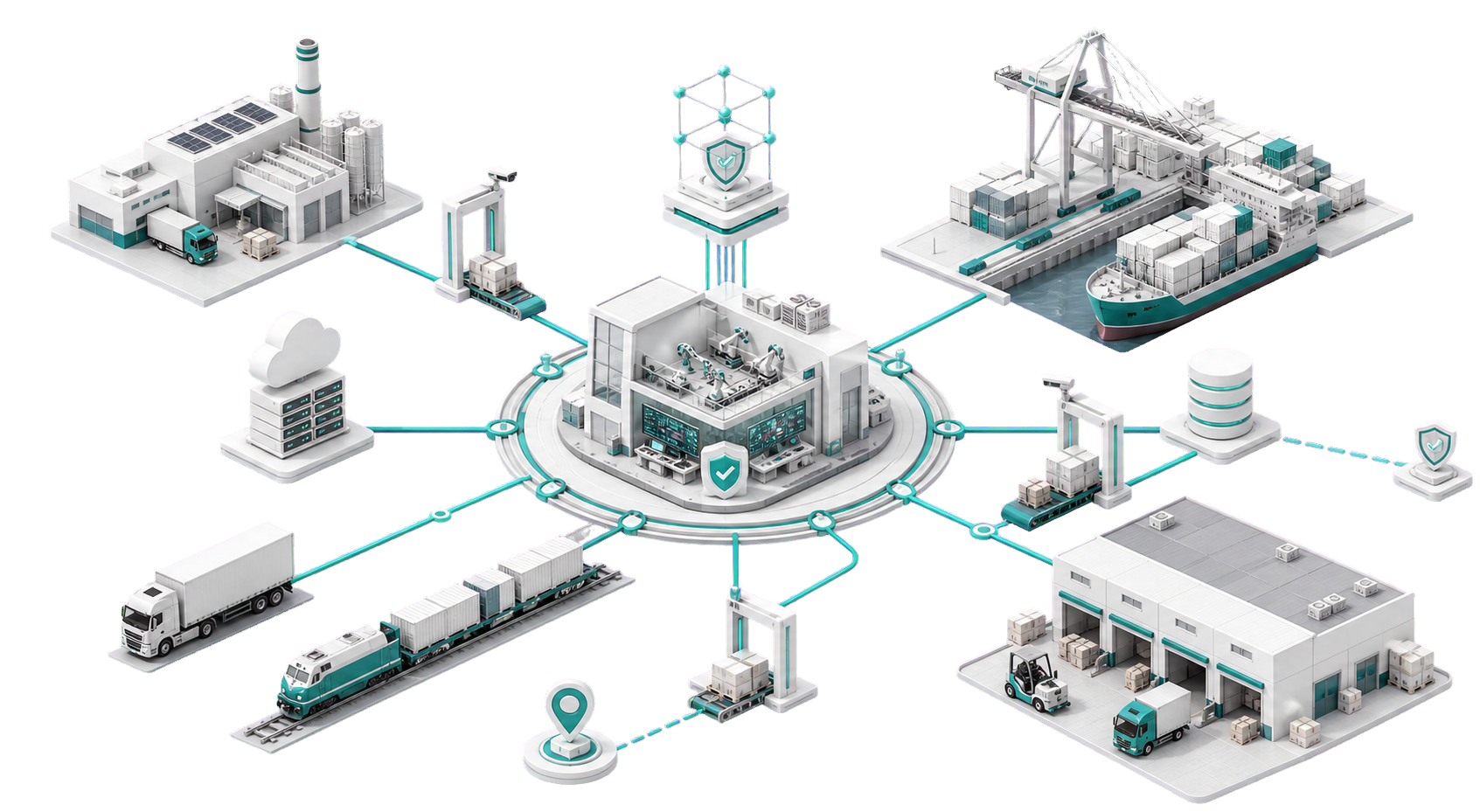
Pricing, sourcing, and customer data each stay inside their own walls — across a stack neither company could stitch alone.
Supply chains run on agents that coordinate across companies, but each company's pricing, sourcing terms, and customer data are confidential data that has to stay inside its own perimeter — no shared SaaS agent platform that sees everyone's data is acceptable to anyone. The alternative, every partner self-hosting a different stitched stack with its own identity model and shared API keys, gives cross-organization chaos and a one-sided audit. Visca is one self-hosted ecosystem each company runs in its own walls, federating identity and scoped access across the boundary so partners' agents interoperate while every company's data stays home.
Why the data can't leave
Partner integrations run on shared API keys and standing access. Revoking one partner means rotating secrets everywhere; auditing what a partner's agent did is a support ticket.
Each organization has its own identity model. There's no shared way to say 'this action was taken by that partner's agent, under this specific grant.'
When something goes wrong at a boundary, each side has half the story in a different format. Reconciling them is slow and contested.
One ecosystem, not a stitched stack
A partner's agent acts on a scoped, time-bound grant you issued — not a shared secret. Revoke it unilaterally, instantly.
Agents discover and reach partner capabilities by descriptor, with mTLS rooted in Sigil identities — across organizational boundaries.
Cross-organization trust federation means an action by a partner's agent is cryptographically attributable, on your side and theirs.
Both organizations get a tamper-evident record of every cross-boundary action — same event, two authoritative copies.
What you get
Relevant frameworks
Visca Cloud has not yet completed formal certification against these frameworks; the stack is architected to meet them and audits are in progress. See the compliance roadmap.
In practice
A logistics partner's agent files customs paperwork on the manufacturer's behalf. The manufacturer issued a Capability Grant scoped to that filing, for that shipment, valid for the transit window. Plexus routes the call with mTLS rooted in both Sigils. Chronicle records the action in both organizations' ledgers — the same event, two authoritative, reconcilable copies.
Account data, balances, and PII can't go to a hosted model. The whole stack has to run inside the bank.
PHI can't be shipped to a model API. The scribe, the audit, and the model all have to live in your tenancy.
Operational telemetry stays on-site, and software agents and robots run on one self-hosted ecosystem.
Classified and sensitive data never leaves the boundary — so the entire stack has to run inside it, air-gapped.
Process recipes and plant telemetry stay on the floor — on one self-hosted ecosystem, not a stack stitched per vendor.
The whole stack. Self-hosted. One ecosystem.
Models, identity, tools, voice, payments, runtime, and audit — as one integrated ecosystem, self-hosted, sovereign, air-gapped. Nothing stitched from vendors. Nothing leaves your perimeter. Open at the core. No license rug-pulls, ever.