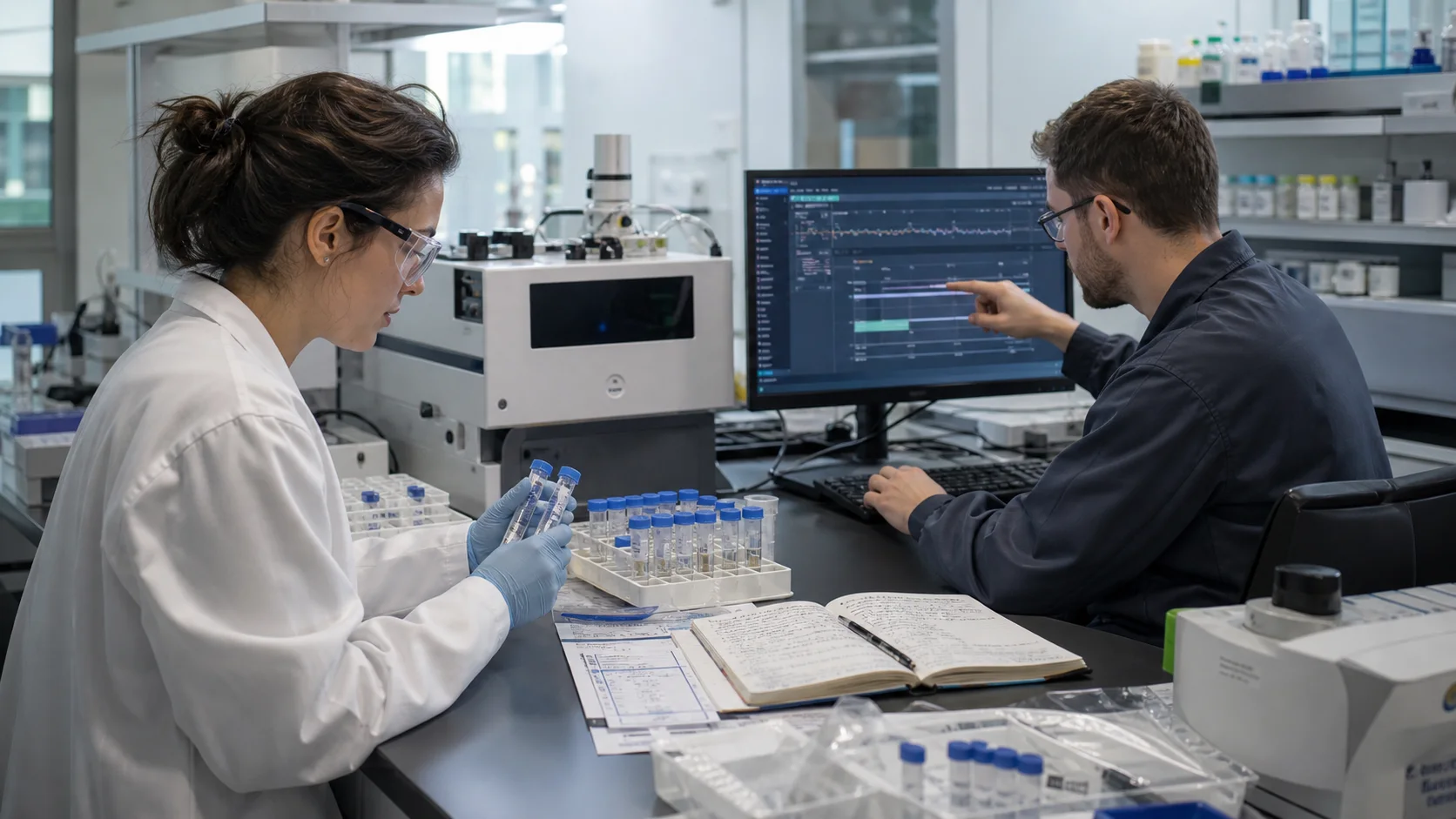
The laboratory scenario below is illustrative. This is a proposal for evidence-aware workflow design, not a validated laboratory procedure. W3C PROV-DM is cited for its provenance vocabulary, not as evidence that a particular experiment is correct.
An agent delivers a clean chart and a confident conclusion: the new material performed better. The reviewer asks which measurements were excluded. Then which protocol version was used. Then whether the samples were labeled before or after the run. Each answer requires another search. The chart is finished; the result is not yet defensible.
In this illustrative materials experiment, the central design question is not how quickly the agent can produce a report. It is whether somebody who did not watch the run can reconstruct the path from samples to claim, identify uncertainty, and challenge the decisions along that path.
The unit of work is the evidence chain
Start with a modest record: the question being investigated, the sample identifiers, the intended procedure and its version, the responsible people, and the observations expected from the instrument. Attach the actual run to that record. If the procedure changes, record the change as a new decision rather than silently editing the plan that supposedly governed the past.
W3C PROV-DM provides a useful vocabulary for this relationship. It distinguishes entities, activities, and responsible agents, including derivation and attribution. That vocabulary can describe how a processed dataset came from an observation and which activity produced it. It does not establish that the observation was accurate or the analysis appropriate.
For our experiment, this means the report can point to the processed table, the table to the transformation, and the transformation to the original readings and identified samples. The instrument’s relevant state belongs alongside the run. The exact fields should follow the laboratory’s method, rather than a universal checklist invented by the software.
Observation and inference must remain separate
Suppose one reading differs sharply from the others. There are several possible records here: the value as received, the agent’s suspicion that it is anomalous, a proposed exclusion, and the reviewer’s decision. Storing only the final cleaned dataset erases the distinction between a measurement and a judgment about that measurement.
The agent should preserve the original observation and produce a separately identified transformed result. The transformation needs enough information to explain what changed: which inputs, which analysis version, and which parameters mattered. The interpretation then cites that result and states its limits. A polished sentence should never be the only place where these decisions survive.
This separation helps when an interpretation changes. A reviewer may accept the readings but reject the comparison because the groups were prepared differently. That should invalidate the affected conclusion without implying that every observation is false. Evidence systems need to represent disagreement at the right level.
Humans define the consequential boundary
An approval request should present the decision that actually needs judgment. “Continue?” is too vague if continuing means excluding a sample or starting another run. A useful request names the proposed deviation, its reason, the affected material, and what accepting it will allow next.
The approval should bind to the relevant version of that proposal. If the agent subsequently changes the sample set or procedure, the earlier approval may no longer cover the action. The system should make that mismatch visible instead of treating a positive chat reply as indefinite permission.
These boundaries are set by the responsible laboratory and its procedures. An agent can assemble the evidence for a decision, but an attractive interface cannot substitute for appropriate scientific oversight or instrument controls. The goal is to make the existing responsibility easier to exercise and harder to misunderstand.
Missing evidence is a state, not an invitation to guess
Now imagine the instrument completed a run, but the connection dropped before the readings were recorded. The work system should distinguish “requested,” “instrument reports complete,” and “results received.” Collapsing those into “done” makes the report look more certain than the record supports.
Recovery might involve retrieving the instrument’s retained output, asking an operator to reconcile the run, or declaring the result unavailable. Repeating the operation automatically is not always appropriate: it may consume material or produce a different observation. The agent should expose the missing link and the available recovery choices.
There is also a tradeoff in how much to capture. Recording every possible signal can create storage, privacy, and review burdens without helping the scientific question. Define the required evidence before execution, preserve unexpected events that affect interpretation, and make omissions explicit. More data is not automatically a better account.
Reproducibility becomes an operating property
A connected record can make later review and repetition easier, but it does not guarantee that another run will yield the same result. Materials, instruments, and conditions may differ. The record’s job is to reveal what was done and what is known about those differences, not to promise an identical outcome.
Evaluate the workflow with a reviewer who did not participate. Can they identify the inputs behind a particular chart? Can they distinguish measured values from inferred labels? Can they discover the exclusion without reading every message? Can they rerun the recorded analysis when its inputs and required environment are available?
Also test correction: withdraw an approval, replace a mistaken sample label, or discover that an input file was incomplete. The affected conclusions should become reviewable rather than remain silently current. A usable evidence chain supports this everyday revision as well as the final report. Its value is the work it lets another person inspect.
A scientific agent should leave a result that another person can question, trace, and revise—not merely a document that sounds complete.