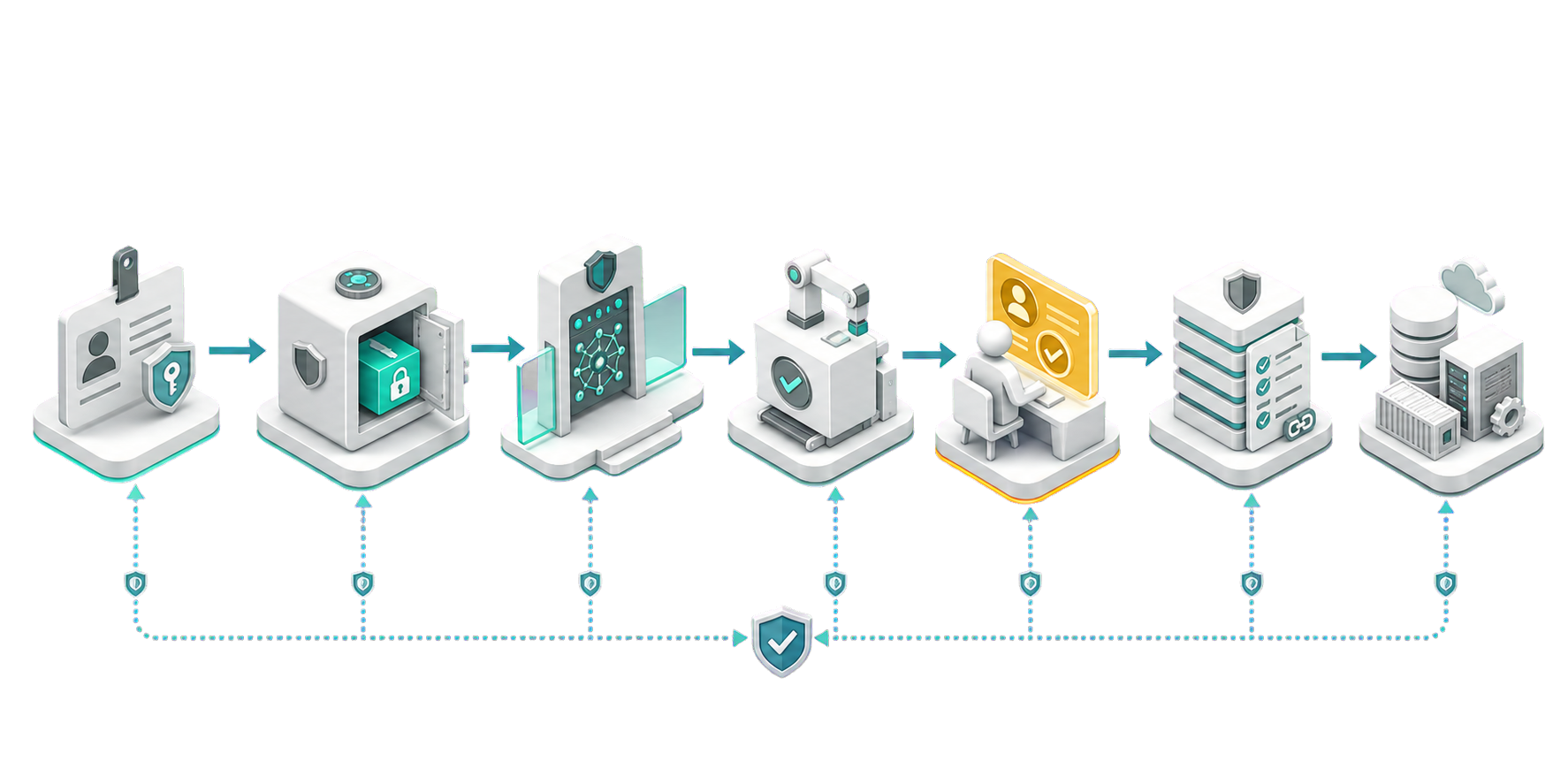
One stack, not a stitched one
How the stack answers the review, applied to security & compliance.
Identity
No actor without identity
Least-privilege starts with knowing who's acting. Every agent is a named principal with a verifiable identity, by construction — 'who is this agent' has one answer.
Credentials
No access without a scoped grant
Long-lived credentials disappear. Every access is scoped, time-bound, consented where required, and audited — least-privilege as the only available mode.
Runtime
Nothing leaves the perimeter
Models, prompts, and data execute inside your walls. The egress finding never opens, and there's no vendor chain to review one contract at a time.
Audit
No action unaccounted for
Every operation is a principal acting within a scope through one governed gateway — append-only, chained, exportable to your SIEM and GRC tooling. The control isn't asserted; it's recorded.
Operators
Maintenance as evidence
Patches, rotations, and recoveries are performed by the stack's own operators as principals in scopes — signed, on the same ledger you read. Humans keep three jobs: declare intent, sign approvals, hold the kill-switch.
In practice
A security review that doesn't block the launch
An application team wants to ship an agent with production access. The review is short: the agent is a named principal, its access is scoped and time-bound, every action lands tamper-evidently on one ledger — and the stack underneath is maintained by operators whose every patch and rotation is on the same record. The controls aren't promises in a doc; they're properties of the runtime, with evidence.