Why Visca
Institutions should be able to build their own software again.
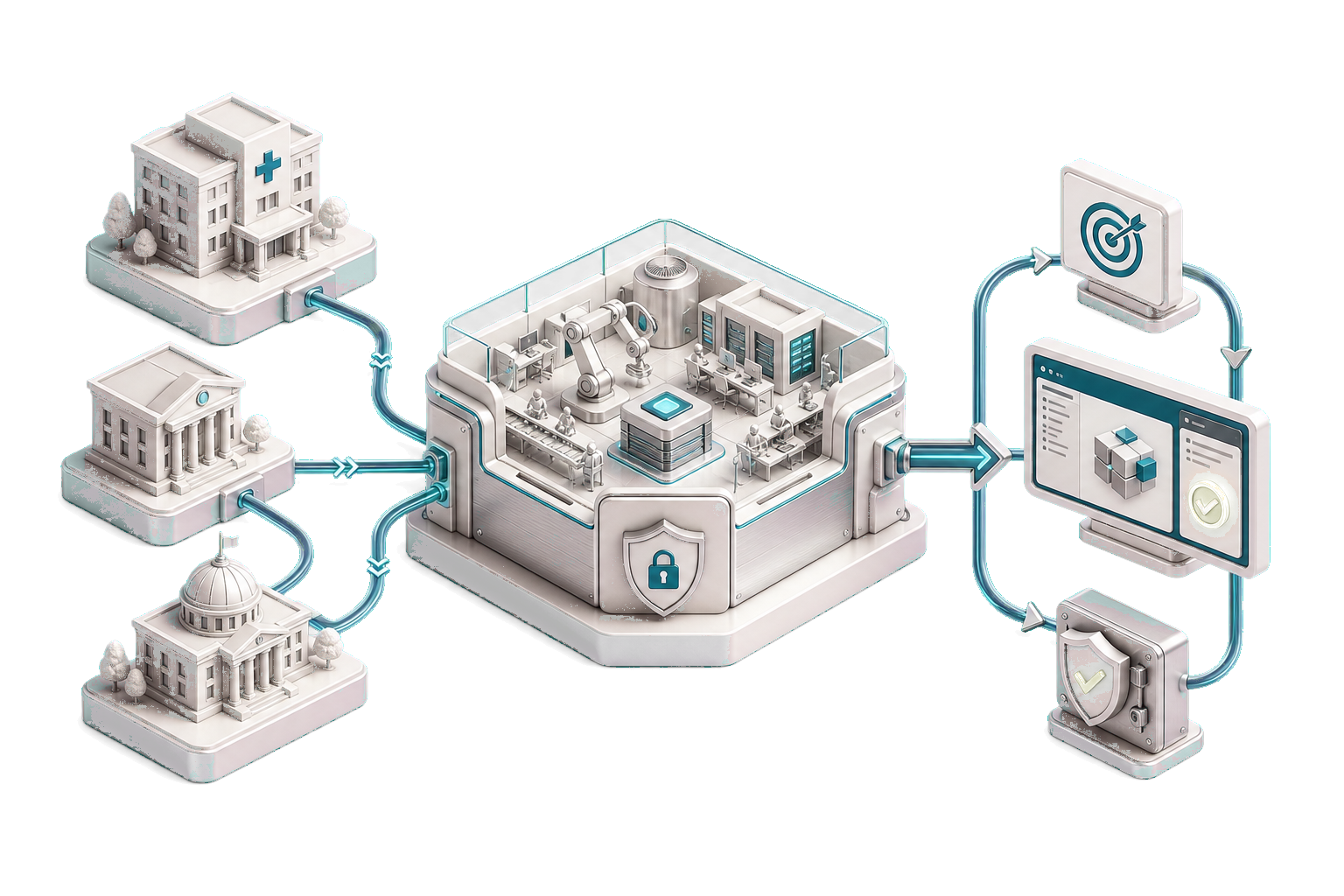
Visca installs the capability to continuously plan, build, test, deploy, and maintain software inside the institution's own network.
Why Visca
Visca installs the capability to continuously plan, build, test, deploy, and maintain software inside the institution's own network.
The dependency
Every unmet workflow becomes a procurement cycle, an integration project, and a permanent vendor dependency. Changes wait on someone else's roadmap while the people closest to the work adapt themselves to the software they bought.
Hospitals, banks, and government agencies feel this most sharply. Their useful context is embedded in sensitive data, internal systems, policy, and practice. Sending that context through a chain of external AI services creates the exact risk their controls are designed to prevent.
The institution needs the capability to create software—not another catalog of software to buy.
The old constraint
Building internally means assembling a team, translating domain needs into tickets, shipping the first version, and then staffing every integration, upgrade, security patch, and incident for as long as the software exists.
That makes bespoke software scarce precisely where the surrounding systems and policies make it most valuable. The backlog grows; the institution falls back to spreadsheets, manual coordination, and software that only approximates the work.
The bottleneck is not ideas. It is the durable capacity to turn them into operated software.
The factory
Visca is an autonomous software factory installed inside the institution's network. Give it an approved objective and its coordinated agents plan the work, build the implementation, test it, prepare the release, and maintain what reaches production.
The factory works where the context already lives. Source, data, models, credentials, and operational records remain inside the perimeter, including sovereign and air-gapped environments.
Do not outsource every application. Own the factory that can keep creating them.
The full lifecycle
Generated code without testing, deployment, and maintenance is another backlog in a new form. Visca carries the work through the lifecycle: verification, approval, release, health checks, upgrades, credential rotation, patches, and incident response.
Resident operator agents do that work inside the network, under the same identity, authority, and record as the agents that built the software.
A factory is measured by operated software, not generated code.
Governed autonomy
Every agent has a verifiable identity. Credentials are scoped and time-bound. Consequential actions can wait for human approval. Deterministic controls can stop the system, and no agent can reason its way around them.
Every operation—including maintenance—is a principal acting within a scope through one governed gateway. The audit trail is not an afterthought; it is the path the work takes.
Humans keep three jobs: declare intent, sign approvals, hold the kill-switch. All three recorded.
Autonomous does not mean ungoverned.
The operating model
The factory runs inside the network, covers the full software lifecycle, and acts through explicit authority. People retain the decisions that should remain human.
Source, data, models, credentials, and operational records remain inside the institution's perimeter. The factory works where the institutional context already lives.
Coordinated agents plan, build, test, deploy, and maintain software. Resident operators keep the resulting systems current inside the perimeter.
Every operation is a principal acting within a scope through one governed gateway, on one record. Autonomy follows explicit authority.
What the system should do is stated by a person, on the record. Agents execute against declared intent — they don't invent it.
Consequential actions wait for a signature. The signature is a recorded event on the same ledger as the action it authorized.
Stopping the system always remains a human decision, never delegated to the agents being stopped. The stop, like everything else, is recorded.
Proven on ourselves first
Healthcare is where privacy, safety, integration, and operational constraints arrive at once. It is the right place to prove that an institution can own the factory—not just the software it produces.
Install an autonomous software factory that plans, builds, tests, deploys, and maintains software inside your network, under your controls.